
library(tidyverse)
library(dagitty)
library(brms)
library(cmdstanr)
library(tidybayes)Supplement 2: Estimate different causal effects in a hypothetical RCT
Introduction of the hypothetical RCT
In our manuscript, we introduce the following hypothetical RCT in the section Running Example for Causal Inference in Longitudinal Study Designs:
Consider a smartphone study in which participants are randomly assigned to use a specific social media app from 8 PM to 10 PM (\(t = 1\)) or not. There is no intervention afterwards, meaning that from 10 PM to midnight (\(t = 2\)), participants can decide for themselves whether to use this app, and this usage is passively recorded. We set \(a_t=1\) if the social media app was used during the time frame indexed by \(t\), while \(a_t=0\) means that the app was not used at all during \(t\). At 10 PM, participants’ rumination (\(L\)) is also measured, as it is hypothesized to be another mediator between social media usage and sleep quality. The final outcome of the study, sleep quality (\(Y\)), is measured the next morning. Figure 1 presents a DAG corresponding to this RCT. Because early social media usage was manipulated in an experiment, there are no arrows pointing into \(A_1\). In contrast, \(A_2\) can be influenced by both \(A_1\) and \(L\). The variable \(U\) represents the set of all unmeasured confounders. Note that in our example, we make the strong assumption that \(U\) is not a direct cause of \(A_2\), and we discuss this potentially implausible assumption in the manuscript section on identification.
In Supplement 1 we showed how to estimate expected potential outcomes and reproduce Table 1 in our manuscript. Here in Supplement 2, we will demonstrate in R how we can simulate and (try to) estimate different total, joint, and direct causal effects.
Demonstration in R
We will use the same DAG and data generating process as in Supplement 1, but will repeat all R code here for completeness.
Load packages
Specify the data generating process
Draw the DAG
Code
dag <- dagitty('dag{
  A1 -> L <- U
  A1 -> A2 <- L
  A1 -> Y <- A2
  L -> Y <- U
  A1[pos="0,2"]
  A2[pos="1,2"]
  Y[pos="1.5,1.5"]
  L[pos="0.5,1.5"]
  U[pos="1,1"]
  }')
plot(dag)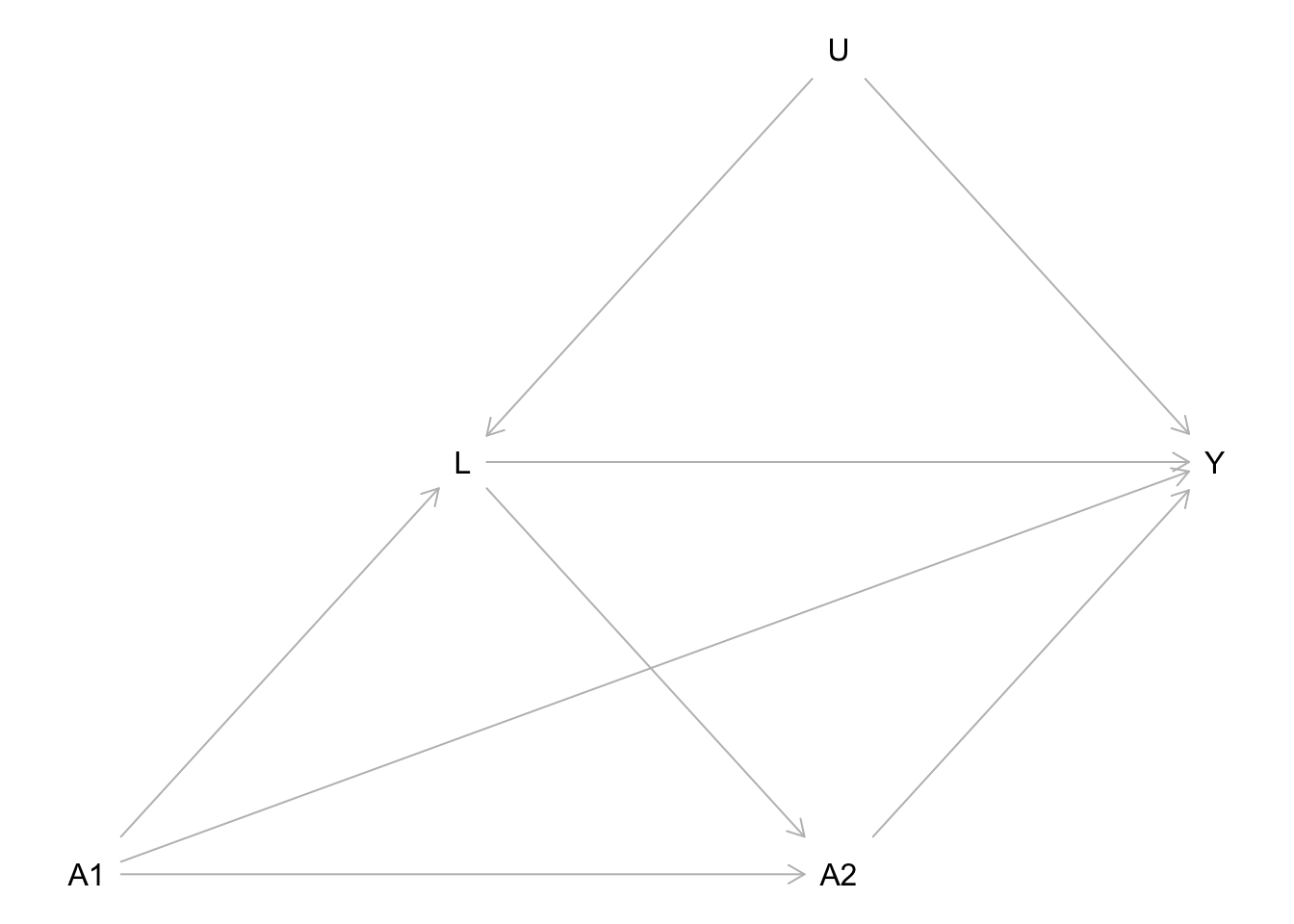
Specify the functional relationships
To showcase joint effect estimation, we again simulate a scenario where \(U\) affects \(A_2\) only through measured \(L\). We discuss situations in which this assumption may be plausible in psychological research—induced by covariate-driven treatment assignment—in the latter half of the manuscript.
b_L_A1 <- 1
b_L_U <- 1
b_A2_A1 <- -3
b_A2_L <- 0.5
b_A2_U <- 0
b_Y_A1 <- -0.1
b_Y_A2 <- -3
b_Y_L <- -1
b_Y_A1A2 <- -0.5
b_Y_U <- -2


f_U <- function(){
  rnorm(n)}
f_A1 <- function(){
  rbinom(n, size = 1, prob = 0.5)}
f_L <- function(A1, U){
  rnorm(n, mean = b_L_A1 * A1 + b_L_U * U)}
f_A2 <- function(A1, L){
  rbinom(n, size = 1, prob = pnorm(b_A2_A1 * A1 + b_A2_L* L + b_A2_U * U))}
f_Y <- function(A1, A2, L, U){
  rnorm(n, mean = 10 + b_Y_A1 * A1 + b_Y_A2 * A2 + b_Y_A1A2 * A1 * A2 + b_Y_L * L +
      b_Y_U * U, sd = 0.1)}
Determine the true causal effects
We will now simulate various causal effects for our hypothetical RCT:
Total effect of A1: \(E(Y^{a_1=1}) - E(Y^{a_1=0})\)
n <- 10000000
set.seed(42)

# Y_1: Y^{a_1=1}

U <- f_U()
A1 <- rep(1, n) # intervention
L <- f_L(A1, U)
A2 <- f_A2(A1, L)
Y_1 <- f_Y(A1, A2, L, U)

# Y_0: Y^{a_1=0}

U <- f_U()
A1 <- rep(0, n) # intervention
L <- f_L(A1, U)
A2 <- f_A2(A1, L)
Y_0 <- f_Y(A1, A2, L, U)

# E(Y_1) - E(Y_0)
(total_A1 <- mean(Y_1) - mean(Y_0))
[1] 0.3257348Joint effect “always - never”: \(E(Y^{a_1=1, a_2=1}) - E(Y^{a_1=0, a_2=0})\)
n <- 10000000
set.seed(42)

# Y_11: Y^{a_1=1, a_2=1}

U <- f_U()
A1 <- rep(1, n) # intervention
L <- f_L(A1, U)
A2 <- rep(1, n) # intervention
Y_11 <- f_Y(A1, A2, L, U)

# Y_00: Y^{a_1=0, a_2=0}

U <- f_U()
A1 <- rep(0, n) # intervention
L <- f_L(A1, U)
A2 <-  rep(0, n) # intervention
Y_00 <- f_Y(A1, A2, L, U)

# E(Y_11) - E(Y_00)
(joint_always <- mean(Y_11) - mean(Y_00))
[1] -4.600175Joint effect “early use”: \(E(Y^{a_1=1, a_2=0}) - E(Y^{a_1=0, a_2=0})\)
n <- 10000000
set.seed(42)

# Y_10: Y^{a_1=1, a_2=0}

U <- f_U()
A1 <- rep(1, n) # intervention
L <- f_L(A1, U)
A2 <- rep(0, n) # intervention
Y_10 <- f_Y(A1, A2, L, U)

# Y_00: Y^{a_1=0, a_2=0}

U <- f_U()
A1 <- rep(0, n) # intervention
L <- f_L(A1, U)
A2 <- rep(0, n) # intervention
Y_00 <- f_Y(A1, A2, L, U)

# E(Y_10) - E(Y_00)
(joint_early <- mean(Y_10) - mean(Y_00))
[1] -1.100175Joint effect “late use”: \(E(Y^{a_1=0, a_2=1}) - E(Y^{a_1=0, a_2=0})\)
n <- 10000000
set.seed(42)

# Y_01: Y^{a_1=0, a_2=1}

U <- f_U()
A1 <- rep(0, n) # intervention
L <- f_L(A1, U)
A2 <- rep(1, n) # intervention
Y_10 <- f_Y(A1, A2, L, U)

# Y_00: Y^{a_1=0, a_2=0}

U <- f_U()
A1 <- rep(0, n) # intervention
L <- f_L(A1, U)
A2 <- rep(0, n) # intervention
Y_00 <- f_Y(A1, A2, L, U)

# E(Y_01) - E(Y_00)
(joint_late <- mean(Y_10) - mean(Y_00))
[1] -3.000175Direct effect “always - never”: \(E(Y^{a_1=1, L^{a_1=0}, a_2=1}) - E(Y^{a_1=0, L^{a_1=0}, a_2=0})\)
n <- 10000000
set.seed(42)

# Y_11: Y^{a_1=1, L^{a_1=0}, a_2=1}

U <- f_U()
A1 <- rep(1, n) # intervention
L <- f_L(A1 = rep(0, n), U)
A2 <- rep(1, n) # intervention
Y_10 <- f_Y(A1, A2, L, U)

# Y_00: Y^{a_1=0, L^{a_1=0}, a_2=0}

U <- f_U()
A1 <- rep(0, n) # intervention
L <-  f_L(A1, U)
A2 <-  rep(0, n) # intervention
Y_00 <- f_Y(A1, A2, L, U)

# E(Y_10) - E(Y_00)
(direct_always <- mean(Y_10) - mean(Y_00))
[1] -3.600175Direct effect “early use”: \(E(Y^{a_1=1, L^{a_1=0}, a_2=0}) - E(Y^{a_1=0, L^{a_1=0}, a_2=0})\)
n <- 10000000
set.seed(42)

# Y_10: Y^{a_1=1, L^{a_1=0}, a_2=0}

U <- f_U()
A1 <- rep(1, n) # intervention
L <- f_L(A1 = rep(0, n), U)
A2 <- rep(0, n) # intervention
Y_10 <- f_Y(A1, A2, L, U)

# Y_00: Y^{a_1=0, L^{a_1=0}, a_2=0}

U <- f_U()
A1 <- rep(0, n) # intervention
L <-  f_L(A1, U)
A2 <-  rep(0, n) # intervention
Y_00 <- f_Y(A1, A2, L, U)

# E(Y_10) - E(Y_00)
(direct_early <- mean(Y_10) - mean(Y_00))
[1] -0.1001748Direct effect “late use”: \(E(Y^{a_1=0, L^{a_1=0}, a_2=1}) - E(Y^{a_1=0, L^{a_1=0}, a_2=0})\)
n <- 10000000
set.seed(42)

# Y_01: Y^{a_1=0, L^{a_1=0}, a_2=1}

U <- f_U()
A1 <- rep(0, n) # intervention
L <- f_L(A1, U)
A2 <- rep(1, n) # intervention
Y_01 <- f_Y(A1, A2, L, U)

# Y_00: Y^{a_1=0, L^{a_1=0}, a_2=0}

U <- f_U()
A1 <- rep(0, n) # intervention
L <-  f_L(A1, U)
A2 <-  rep(0, n) # intervention
Y_00 <- f_Y(A1, A2, L, U)

# E(Y_01) - E(Y_00)
(direct_late <- mean(Y_01) - mean(Y_00))
[1] -3.000175Direct effect of A1: \(E(Y^{a_1=1, L^{a_1=0}, A_2^{a_1=0, L^{a_1=0}}}) - E(Y^{a_1=0, L^{a_1=0}, A_2^{a_1=0, L^{a_1=0}}})\)
n <- 10000000
set.seed(42)

# Y_1: Y^{a_1=1, L^{a_1=0}, A_2^{a_1=0, L^{a_1=0}}}

U <- f_U()
A1 <- rep(1, n) # intervention
L <- f_L(A1 = rep(0, n), U)
A2 <- f_A2(A1 = rep(0, n), L)
Y_1 <- f_Y(A1, A2, L, U)

# Y_0: Y^{a_1=0, L^{a_1=0}, A_2^{a_1=0, L^{a_1=0}}}

U <- f_U()
A1 <- rep(0, n) # intervention
L <-  f_L(A1, U)
A2 <- f_A2(A1, L)
Y_0 <- f_Y(A1, A2, L, U)

# E(Y_1) - E(Y_0)
(direct_A1 <- mean(Y_1) - mean(Y_0))
[1] -0.351657Simulate a sample dataset
n <- 2000
set.seed(42)

U <- f_U()
A1 <- f_A1()
L <- f_L(A1, U)
A2 <- f_A2(A1, L)
Y <- f_Y(A1, A2, L, U)

dat <- data.frame(A1, A2, L, Y)
Fit statistical models with brms
In the hypothetical RCT, there was no randomization at \(t = 2\). However, we can still estimate causal effects using our knowledge of the DAG. Causal effects can be retrieved under the assumptions of consistency, exchangeability, and positivity.
Different statistical models are required to estimate various total, joint, and direct effects. To estimate the joint effect, we ensure exchangeability by leveraging the property that, given \(L\) and \(A_1\), \(A_2\) is independent of \(U\): \(P(A_2 = a_2 | A_1, L, U) = P(A_2 = a_2 | A_1, L)\).
set.seed(42)
fit_total <- brm(Y ~ A1,
  data = dat, chains = 4, cores = 4, backend = "cmdstanr", refresh = 0)
Running MCMC with 4 parallel chains...
Chain 1 finished in 0.1 seconds.
Chain 2 finished in 0.1 seconds.
Chain 3 finished in 0.1 seconds.
Chain 4 finished in 0.1 seconds.
All 4 chains finished successfully.
Mean chain execution time: 0.1 seconds.
Total execution time: 0.2 seconds.summary(fit_total) Family: gaussian
Links: mu = identity; sigma = identity
Formula: Y ~ A1
Data: dat (Number of observations: 2000)
Draws: 4 chains, each with iter = 2000; warmup = 1000; thin = 1;
total post-warmup draws = 4000
Regression Coefficients:
Estimate Est.Error l-95% CI u-95% CI Rhat Bulk_ESS Tail_ESS
Intercept 8.62 0.12 8.38 8.85 1.00 3669 2699
A1 0.22 0.16 -0.10 0.55 1.00 4111 2991
Further Distributional Parameters:
Estimate Est.Error l-95% CI u-95% CI Rhat Bulk_ESS Tail_ESS
sigma 3.67 0.06 3.56 3.79 1.00 4181 3032
Draws were sampled using sample(hmc). For each parameter, Bulk_ESS
and Tail_ESS are effective sample size measures, and Rhat is the potential
scale reduction factor on split chains (at convergence, Rhat = 1).set.seed(42)
bf_L <- bf(L ~ A1)
bf_Y <- bf(Y ~ A1 + A2 + A1:A2 + L)
fit_joint <- brm(bf_L + bf_Y + set_rescor(FALSE),
data = dat, chains = 4, cores = 4, backend = "cmdstanr", refresh = 0)Running MCMC with 4 parallel chains...
Chain 1 finished in 0.2 seconds.
Chain 2 finished in 0.2 seconds.
Chain 3 finished in 0.2 seconds.
Chain 4 finished in 0.2 seconds.
All 4 chains finished successfully.
Mean chain execution time: 0.2 seconds.
Total execution time: 0.3 seconds.summary(fit_joint) Family: MV(gaussian, gaussian)
Links: mu = identity; sigma = identity
mu = identity; sigma = identity
Formula: L ~ A1
Y ~ A1 + A2 + A1:A2 + L
Data: dat (Number of observations: 2000)
Draws: 4 chains, each with iter = 2000; warmup = 1000; thin = 1;
total post-warmup draws = 4000
Regression Coefficients:
Estimate Est.Error l-95% CI u-95% CI Rhat Bulk_ESS Tail_ESS
L_Intercept -0.06 0.04 -0.15 0.03 1.00 6379 3045
Y_Intercept 9.94 0.07 9.81 10.07 1.00 3419 2984
L_A1 1.04 0.06 0.92 1.17 1.00 6719 3107
Y_A1 0.95 0.09 0.78 1.12 1.00 2967 2975
Y_A2 -2.92 0.10 -3.11 -2.74 1.00 3263 3119
Y_L -2.00 0.02 -2.05 -1.95 1.00 4845 3227
Y_A1:A2 -0.25 0.27 -0.78 0.29 1.00 5005 3428
Further Distributional Parameters:
Estimate Est.Error l-95% CI u-95% CI Rhat Bulk_ESS Tail_ESS
sigma_L 1.42 0.02 1.38 1.47 1.00 7518 2878
sigma_Y 1.41 0.02 1.37 1.45 1.00 7069 3101
Draws were sampled using sample(hmc). For each parameter, Bulk_ESS
and Tail_ESS are effective sample size measures, and Rhat is the potential
scale reduction factor on split chains (at convergence, Rhat = 1).set.seed(42)
bf_L <- bf(L ~ A1)
bf_A2 <- bf(A2 ~ A1 + L, family = bernoulli(link = probit))
bf_Y <- bf(Y ~ A1 + A2 + A1:A2 + L)
fit_direct <- brm(bf_L + bf_A2 + bf_Y + set_rescor(FALSE),
data = dat, chains = 4, cores = 4, backend = "cmdstanr", refresh = 0)Running MCMC with 4 parallel chains...Chain 1 finished in 2.3 seconds.
Chain 2 finished in 2.4 seconds.
Chain 4 finished in 2.4 seconds.
Chain 3 finished in 2.5 seconds.
All 4 chains finished successfully.
Mean chain execution time: 2.4 seconds.
Total execution time: 2.6 seconds.summary(fit_direct) Family: MV(gaussian, bernoulli, gaussian)
Links: mu = identity; sigma = identity
mu = probit
mu = identity; sigma = identity
Formula: L ~ A1
A2 ~ A1 + L
Y ~ A1 + A2 + A1:A2 + L
Data: dat (Number of observations: 2000)
Draws: 4 chains, each with iter = 2000; warmup = 1000; thin = 1;
total post-warmup draws = 4000
Regression Coefficients:
Estimate Est.Error l-95% CI u-95% CI Rhat Bulk_ESS Tail_ESS
L_Intercept -0.06 0.05 -0.15 0.03 1.00 5199 3225
A2_Intercept 0.00 0.05 -0.09 0.09 1.00 5676 2987
Y_Intercept 9.94 0.07 9.82 10.07 1.00 2978 2936
L_A1 1.04 0.06 0.92 1.17 1.00 5424 3241
A2_A1 -2.83 0.13 -3.08 -2.58 1.00 2437 2966
A2_L 0.50 0.03 0.44 0.57 1.00 3249 3052
Y_A1 0.95 0.09 0.77 1.12 1.00 2403 2728
Y_A2 -2.92 0.10 -3.11 -2.73 1.00 2937 2915
Y_L -2.00 0.02 -2.05 -1.95 1.00 3521 3206
Y_A1:A2 -0.25 0.29 -0.84 0.31 1.00 4778 3432
Further Distributional Parameters:
Estimate Est.Error l-95% CI u-95% CI Rhat Bulk_ESS Tail_ESS
sigma_L 1.42 0.02 1.38 1.47 1.00 4393 2804
sigma_Y 1.41 0.02 1.36 1.46 1.00 5205 3063
Draws were sampled using sample(hmc). For each parameter, Bulk_ESS
and Tail_ESS are effective sample size measures, and Rhat is the potential
scale reduction factor on split chains (at convergence, Rhat = 1).Estimate the causal effects
params_total <- tidy_draws(fit_total)
params_joint <- tidy_draws(fit_joint)
params_direct <- tidy_draws(fit_direct)
N <- 10000

# total effect A1
total_A1_est <- params_total |>
  group_by(.draw) |>
  mutate(
    E_Y_1 = {
      a1 <- rep(1, N)
      y <- rnorm(N, b_Intercept + b_A1 * a1, sd = sigma)
      mean(y)},
    E_Y_0 = {
      a1 <- rep(0, N)
      y <- rnorm(N, b_Intercept + b_A1 * a1, sd = sigma)
      mean(y)}) |>
  mutate(E_Y_diff = E_Y_1 - E_Y_0) |>
  ungroup() |> select(E_Y_diff) |>
  summarise_draws()

# joint effect always - never
joint_always_est <- params_joint |>
  group_by(.draw) |>
  mutate(
    E_Y_11 = {
      a1 <- rep(1, N)
      l <- rnorm(N, b_L_Intercept + b_L_A1 * a1, sd = sigma_L)
      a2 <- rep(1, N)
      y <- rnorm(N, b_Y_Intercept + b_Y_A1 * a1 + b_Y_A2 * a2 + `b_Y_A1:A2` * a1 * a2 +
          b_Y_L * l, sd = sigma_Y)
      mean(y)},
    E_Y_00 = {
      a1 <- rep(0, N)
      l <- rnorm(N, b_L_Intercept + b_L_A1 * a1, sd = sigma_L)
      a2 <- rep(0, N)
      y <- rnorm(N, b_Y_Intercept + b_Y_A1 * a1 + b_Y_A2 * a2 + `b_Y_A1:A2` * a1 * a2 +
          b_Y_L * l, sd = sigma_Y)
      mean(y)}) |>
  mutate(E_Y_diff = E_Y_11 - E_Y_00) |>
  ungroup() |> select(E_Y_diff) |>
  summarise_draws()

# joint effect early use
joint_early_est <- params_joint |>
  group_by(.draw) |>
  mutate(
    E_Y_10 = {
      a1 <- rep(1, N)
      l <- rnorm(N, b_L_Intercept + b_L_A1 * a1, sd = sigma_L)
      a2 <- rep(0, N)
      y <- rnorm(N, b_Y_Intercept + b_Y_A1 * a1 + b_Y_A2 * a2 + `b_Y_A1:A2` * a1 * a2 +
          b_Y_L * l, sd = sigma_Y)
      mean(y)},
    E_Y_00 = {
      a1 <- rep(0, N)
      l <- rnorm(N, b_L_Intercept + b_L_A1 * a1, sd = sigma_L)
      a2 <- rep(0, N)
      y <- rnorm(N, b_Y_Intercept + b_Y_A1 * a1 + b_Y_A2 * a2 + `b_Y_A1:A2` * a1 * a2 +
          b_Y_L * l, sd = sigma_Y)
      mean(y)}) |>
  mutate(E_Y_diff = E_Y_10 - E_Y_00) |>
  ungroup() |> select(E_Y_diff) |>
  summarise_draws()

# joint effect late use
joint_late_est <- params_joint |>
  group_by(.draw) |>
  mutate(
    E_Y_01 = {
      a1 <- rep(0, N)
      l <- rnorm(N, b_L_Intercept + b_L_A1 * a1, sd = sigma_L)
      a2 <- rep(1, N)
      y <- rnorm(N, b_Y_Intercept + b_Y_A1 * a1 + b_Y_A2 * a2 + `b_Y_A1:A2` * a1 * a2 +
          b_Y_L * l, sd = sigma_Y)
      mean(y)},
    E_Y_00 = {
      a1 <- rep(0, N)
      l <- rnorm(N, b_L_Intercept + b_L_A1 * a1, sd = sigma_L)
      a2 <- rep(0, N)
      y <- rnorm(N, b_Y_Intercept + b_Y_A1 * a1 + b_Y_A2 * a2 + `b_Y_A1:A2` * a1 * a2 +
          b_Y_L * l, sd = sigma_Y)
      mean(y)}) |>
  mutate(E_Y_diff = E_Y_01 - E_Y_00) |>
  ungroup() |> select(E_Y_diff) |>
  summarise_draws()

# direct effect always - never
direct_always_est <- params_joint |>
  group_by(.draw) |>
  mutate(
    E_Y_11 = {
      a1 <- rep(1, N)
      a1_0 <- rep(0, N)
      l <- rnorm(N, b_L_Intercept + b_L_A1 * a1_0, sd = sigma_L)
      a2 <- rep(1, N)
      y <- rnorm(N, b_Y_Intercept + b_Y_A1 * a1 + b_Y_A2 * a2 + `b_Y_A1:A2` * a1 * a2 +
          b_Y_L * l, sd = sigma_Y)
      mean(y)},
    E_Y_00 = {
      a1 <- rep(0, N)
      l <- rnorm(N, b_L_Intercept + b_L_A1 * a1, sd = sigma_L)
      a2 <- rep(0, N)
      y <- rnorm(N, b_Y_Intercept + b_Y_A1 * a1 + b_Y_A2 * a2 + `b_Y_A1:A2` * a1 * a2 +
          b_Y_L * l, sd = sigma_Y)
      mean(y)}) |>
  mutate(E_Y_diff = E_Y_11 - E_Y_00) |>
  ungroup() |> select(E_Y_diff) |>
  summarise_draws()

# direct effect early use
direct_early_est <- params_joint |>
  group_by(.draw) |>
  mutate(
    E_Y_10 = {
      a1 <- rep(1, N)
      a1_0 <- rep(0, N)
      l <- rnorm(N, b_L_Intercept + b_L_A1 * a1_0, sd = sigma_L)
      a2 <- rep(0, N)
      y <- rnorm(N, b_Y_Intercept + b_Y_A1 * a1 + b_Y_A2 * a2 + `b_Y_A1:A2` * a1 * a2 +
          b_Y_L * l, sd = sigma_Y)
      mean(y)},
    E_Y_00 = {
      a1 <- rep(0, N)
      l <- rnorm(N, b_L_Intercept + b_L_A1 * a1, sd = sigma_L)
      a2 <- rep(0, N)
      y <- rnorm(N, b_Y_Intercept + b_Y_A1 * a1 + b_Y_A2 * a2 + `b_Y_A1:A2` * a1 * a2 +
          b_Y_L * l, sd = sigma_Y)
      mean(y)}) |>
  mutate(E_Y_diff = E_Y_10 - E_Y_00) |>
  ungroup() |> select(E_Y_diff) |>
  summarise_draws()

# direct effect late use
direct_late_est <- params_joint |>
  group_by(.draw) |>
  mutate(
    E_Y_01 = {
      a1 <- rep(0, N)
      l <- rnorm(N, b_L_Intercept + b_L_A1 * a1, sd = sigma_L)
      a2 <- rep(1, N)
      y <- rnorm(N, b_Y_Intercept + b_Y_A1 * a1 + b_Y_A2 * a2 + `b_Y_A1:A2` * a1 * a2 +
          b_Y_L * l, sd = sigma_Y)
      mean(y)},
    E_Y_00 = {
      a1 <- rep(0, N)
      l <- rnorm(N, b_L_Intercept + b_L_A1 * a1, sd = sigma_L)
      a2 <- rep(0, N)
      y <- rnorm(N, b_Y_Intercept + b_Y_A1 * a1 + b_Y_A2 * a2 + `b_Y_A1:A2` * a1 * a2 +
          b_Y_L * l, sd = sigma_Y)
      mean(y)}) |>
  mutate(E_Y_diff = E_Y_01 - E_Y_00) |>
  ungroup() |> select(E_Y_diff) |>
  summarise_draws()

# direct effect A1
direct_A1_est <- params_direct |>
  group_by(.draw) |>
  mutate(
    E_Y_1 = {
      a1 <- rep(1, N)
      a1_0 <- rep(0, N)
      l <- rnorm(N, b_L_Intercept + b_L_A1 * a1_0, sd = sigma_L)
      a2 <- rbinom(N, size = 1, prob = pnorm(b_A2_Intercept + b_A2_A1 * a1_0 + b_A2_L * l))
      y <- rnorm(N, b_Y_Intercept + b_Y_A1 * a1 + b_Y_A2 * a2 + `b_Y_A1:A2` * a1 * a2 +
          b_Y_L * l, sd = sigma_Y)
      mean(y)},
    E_Y_0 = {
      a1 <- rep(0, N)
      l <- rnorm(N, b_L_Intercept + b_L_A1 * a1, sd = sigma_L)
      a2 <- rbinom(N, size = 1, prob = pnorm(b_A2_Intercept + b_A2_A1 * a1 + b_A2_L * l))
      y <- rnorm(N, b_Y_Intercept + b_Y_A1 * a1 + b_Y_A2 * a2 + `b_Y_A1:A2` * a1 * a2 +
          b_Y_L * l, sd = sigma_Y)
      mean(y)}) |>
  mutate(E_Y_diff = E_Y_1 - E_Y_0) |>
  ungroup() |> select(E_Y_diff) |>
  summarise_draws()
Compare the true causal effects with their empirical estimates
Code
table <- tribble(
 ~"causal effect"               ,~"true effect" ,~"estimate (med)"        ,~"ci (q2.5)"           ,~"ci (q97.5)",
  "total effect A1"             , total_A1      , total_A1_est$median     , total_A1_est$q5     , total_A1_est$q95     ,
  "joint effect always - never" , joint_always  , joint_always_est$median , joint_always_est$q5 , joint_always_est$q95 ,
  "joint effect early use"      , joint_early   , joint_early_est$median  , joint_early_est$q5  , joint_early_est$q95  ,
  "joint effect late use"       , joint_late    , joint_late_est$median   , joint_late_est$q5   , joint_late_est$q95   ,
  "direct effect always - never", direct_always , direct_always_est$median, direct_always_est$q5, direct_always_est$q95,
  "direct effect early use"     , direct_early  , direct_early_est$median , direct_early_est$q5 , direct_early_est$q95 ,
  "direct effect late use"      , direct_late   , direct_late_est$median  , direct_late_est$q5  , direct_late_est$q95  ,
  "direct effect A1"            , direct_A1     , direct_A1_est$median    , direct_A1_est$q5    , direct_A1_est$q95    ,

)
knitr::kable(table)| causal effect | true effect | estimate (med) | ci (q2.5) | ci (q97.5) |
|---|---|---|---|---|
| total effect A1 | 0.3257348 | 0.2219661 | -0.0601195 | 0.5047605 |
| joint effect always - never | -4.6001748 | -4.3157444 | -4.8158236 | -3.8104642 |
| joint effect early use | -1.1001748 | -1.1365596 | -1.3962049 | -0.8839994 |
| joint effect late use | -3.0001748 | -2.9251223 | -3.0979420 | -2.7480792 |
| direct effect always - never | -3.6001748 | -2.2275346 | -2.6955974 | -1.7778516 |
| direct effect early use | -0.1001748 | 0.9491820 | 0.7884349 | 1.1102144 |
| direct effect late use | -3.0001748 | -2.9262275 | -3.0978062 | -2.7513584 |
| direct effect A1 | -0.3516570 | 0.8259555 | 0.5603612 | 1.0852940 |
Note that the total and joint effects are estimated without bias, while the direct effects are biased because of the unobserved confounder \(U\) (except for the direct effect of “late use”, which for our data generating process is equal to the joint effect of “late use”).
Reuse
Citation
BibTeX citation:
@article{junker2025,
  author = {Junker, Lukas and Schoedel, Ramona and Pargent, Florian},
  title = {Towards a {Clearer} {Understanding} of {Causal} {Estimands:}
    {The} {Importance} of {Joint} {Effects} in {Longitudinal} {Designs}
    with {Time-Varying} {Treatments.}},
  journal = {PsyArXiv},
  date = {2025},
  url = {https://FlorianPargent.github.io/joint_effects_ampps/supplement_2.html},
  doi = {10.31234/osf.io/zmh5a},
  langid = {en}
}
For attribution, please cite this work as:
Junker, L., Schoedel, R., & Pargent, F. (2025). Towards a Clearer
Understanding of Causal Estimands: The Importance of Joint Effects in
Longitudinal Designs with Time-Varying Treatments. PsyArXiv. https://doi.org/10.31234/osf.io/zmh5a